An Australian charity receiving over $200 million in tax-deductible donations is ignoring international law, while the Government looks the other way. Stephanie Tran reports.
Jewish National Fund Australia (JNF Australia) has remitted more than $125.4m to Israel since 2009, according to financial records, while receiving $213m in tax-deductible donations since 2013.
In 2024 alone, the organisation reported $12m in donations and bequests, with $10.4m transferred to Israel.
Despite JNF Australia’s assertion that it operates independently of its Israeli parent, Keren Kayemet LeYisrael (KKL-JNF), an investigation by MWM has revealed that tax-deductible donations raised by JNF Australia have been directly transferred to KKL-JNF. Some of these funds have been used to support IDF soldiers and fund illegal settlements.
Independent really?
NF Australia has repeatedly stated that it operates independently of KKL-JNF in Israel.
In 2017, Israeli Prime Minister Benjamin Netanyahu demanded that KKL-JNF transfer 80% of its revenue to the Finance Ministry to help fund state-run infrastructure projects or risk losing its tax-exempt status.
Following the announcement, JNF Australia declared that it was a “separate independent entity” from KKL-JNF. They stated that “funds raised by JNF Australia go directly towards these projects, with not one dollar used to fund KKL”
In 2021, KKL-JNF’s board voted to officially permit the purchase of private land in the occupied West Bank for settlement expansion, a decision that was criticised as an open violation of international law.
Shortly after the decision, JNF Australia’s president and CEO again attempted to distance the organisation from its Israeli parent, stating that the Australian body was “an independent entity from KKL”.
“JNF Australia only applies donor contributions towards JNF Australia projects and priorities [and] is therefore unaffected by any changes to KKL’s priorities and policies, whether in respect to land acquisition or elsewhere,” they said, adding that the organisation “has no representatives on the KKL board, nor is it involved with or bound by any of their decisions”.
However, our analysis of Israeli financial filings shows that JNF Australia has transferred millions of dollars directly to KKL-JNF (also known as the Israel National Fund) since making these statements.
Although the sources of foreign donations were redacted in Israel National Fund’s 2024 financial report, financial reports lodged in previous years identify Australia as a source of overseas donations.
Between 2021 and 2024, KKL-JNF received 41.86m Shekels ($19.4 million) in donations from Australia and New Zealand.
The financial reports state that these donations “are received from residents of various countries, including through KKL-JNF offices abroad”.
The Jewish National Fund was founded in 1901 to purchase land in Palestine for Jewish settlement, decades before the establishment of Israel. Over the past century, KKL-JNF has played a central role in land acquisition and large-scale “forestation” projects across the occupied Palestinian territories.
These activities have long been intertwined with the displacement of Palestinians. An investigation by Haaretz revealed that the Israeli Defence Ministry recruited KKL-JNF to secretly purchase Palestinian land in the West Bank for settlers. Israeli NGO Zochrot has accused JNF of contributing to the “ongoing Nakba” through projects that plant forests or develop parks on land where Palestinian communities once stood, while supporting illegal settlement initiatives.
In July 2024, the International Court of Justice (ICJ) issued a landmark advisory opinion finding that Israel’s occupation of Palestinian territory is illegal under international law.
The ICJ held that Israel must end its presence in the Occupied Palestinian Territory as rapidly as possible, and immediately cease all new settlement activity. The Court also held that third states have an obligation “not to render aid or assistance in maintaining the situation created by Israel’s illegal presence in the Occupied Palestinian Territory”.
In a subsequent position paper responding to the ruling, the United Nations Independent International Commission of Inquiry on the Occupied Palestinian Territory, including East Jerusalem and Israel, said states should not provide tax deductibility for donations to organisations that support illegal occupation.
JNF supporting illegal settlements
The Jewish National Fund was founded in 1901 to purchase land in Palestine for Jewish settlement, decades before the establishment of Israel. Over the past century, KKL-JNF has played a central role in land acquisition and large-scale “forestation” projects across the occupied Palestinian territories.These activities have long been intertwined with the displacement of Palestinians. An investigation by Haaretz revealed that the Israeli Defence Ministry recruited KKL-JNF to secretly purchase Palestinian land in the West Bank for settlers. Israeli NGO Zochrot has accused JNF of contributing to the “ongoing Nakba” through projects that plant forests or develop parks on land where Palestinian communities once stood, while supporting illegal settlement initiatives.
In July 2024, the International Court of Justice (ICJ) issued a landmark advisory opinion finding that Israel’s occupation of Palestinian territory is illegal under international law.
The ICJ held that Israel must end its presence in the Occupied Palestinian Territory as rapidly as possible, and immediately cease all new settlement activity. The Court also held that third states have an obligation “not to render aid or assistance in maintaining the situation created by Israel’s illegal presence in the Occupied Palestinian Territory”.
In a subsequent position paper responding to the ruling, the United Nations Independent International Commission of Inquiry on the Occupied Palestinian Territory, including East Jerusalem and Israel, said states should not provide tax deductibility for donations to organisations that support illegal occupation.
“States shall not give support to these organizations, for example, through allowing the organization to have tax-exempt status or providing tax deductibility for donations to the organization and must ensure that financial contributions to support the unlawful occupation, including settlements and settlers, cease,” the Commission said.
Chris Sidoti, a commissioner on the UN inquiry, said the implications for Australian charities that fund Israeli settlements were clear.
“We should end tax deductibility for any Australian charities that provide funding for Israeli settlements or for Israeli organisations that support the establishment or maintenance of settlements,” he said, “Any organisation that is financially or politically supporting the unlawful occupation, including funding settlements,
“should have its tax-exempt status removed and should be deregistered.”
Despite the UN General Assembly adopting a a resolution in September 2024 demanding that Israel end its unlawful occupation no later than 12 months after the adoption of the resolution, the Israeli government has accelerated settlements in the West Bank.
Last month, Israel’s security cabinet repealed land laws, enabling settlers to purchase land in the West Bank without limitation and without government oversight to “enable accelerated development of settlement on the ground”.
Since the US-Israeli war with Iran began, Israel has imposed a total military closure on the West Bank and Israeli settlers have seized the opportunity to expel more Palestinian communities from their land.
Support for IDF soldiers and settlers
Jewish National Fund Australia publicly promotes programs providing financial support to soldiers in the Israel Defense Forces (IDF), including “Ach Gadol”, “Atidim Lone Soldier Education Support” and “Panim el Panim”.
The Ach Gadol initiative offers one-on-one support for “lone soldiers” serving in the IDF. The project aims to create a support system for lone soldiers throughout their army service and “deepen the values of Zionism and love of the land among young new immigrants”.
According to JNF, “there are over 7,000 lone soldiers currently serving in the IDF. About 45% of these soldiers are new immigrants, coming from Jewish communities all over the world.”
Panim-El-Panim is a program launched in cooperation with the IDF Chief Rabbinate to “provide the soldiers with the tools and ability to cope with the complex challenges they face during their military service and life afterwards”. According to JNF Australia, Panim-El-Panim meets with over 90 thousand soldiers annually.
Atidim Lone Soldier Education Support assists lone immigrant soldiers after their service, providing the “support they need to become part of Israel’s vital nation building”.
According to Al Jazeera, more than 50,000 foreign soldiers have fought for IDF during Gaza genocide. 621 of these soldiers are Australian citizens.
JNF Australia has also fundraised for Ateret Cohanim, an extremist settler group active in East Jerusalem. Ateret Cohanim has filed eviction lawsuits against around 100 Palestinian families living in East Jerusalem. JNF Australia removed the fundraiser from its website after members of the Australian Jewish Democratic Society wrote an article about the fundraiser.
Daniel Luria is the executive director and spokesman of Ateret Cohanim later claimed that “Ateret Cohanim does not receive any money from the JNF Australia and Ateret Cohanim has not appeared on the JNF site as a partner project.”
MWM put questions to JNF Australia regarding their relationship to KKL-JNF and their funding of IDF soldiers and settlers. They did not respond to the request for comment.
“Public Benevolent Institution”
JNF Australia operates through three charities registered with the Australian Charities and Not-for-profits Commission (ACNC):
All hold deductible gift recipient (DGR) status. The Jewish National Fund (Australia) Pty Limited is also registered as a public benevolent institution (PBI).
Under Australian law, charities must pursue exclusively charitable purposes and comply with governance and external conduct standards, including obligations relating to overseas activities.
PBIs receive the most concessional treatment under Australia’s charity law, including exemption from income tax, eligibility to receive tax-deductible donations, and access to fringe benefits tax concessions not available to most other charities.
The three charities are overseen by the same 8 person board. Doron Lazarus is the CEO of JNF Australia and long-time board member Pamela Krail is the current president.
ACNC response
MWM put questions to the ACNC, regarding whether providing funds to the IDF and illegal settlements was compatible with JNF Australia’s DGR and PBI requirements. They stated that:
“The United Nations’ view that settling civilian populations in an occupied territory is contrary to international law has not, at this stage, been incorporated into domestic Australian law. The ACNC cannot enforce international law unless that law has been incorporated into Australian domestic legislation.”
See the ACNC’s full response below: [on original]
………….Violating international law
Despite the ACNC’s assertion that they “can’t enforce international law”, legal experts say the use of tax-deductible donations to fund projects connected to Israeli settlements and the IDF raises significant issues under both Australian law and international legal obligations.
The Australian Centre for International Justice (ACIJ), which has been monitoring potentially unlawful activities of Australian charities operating in the occupied Palestinian territories, said the legal position regarding settlements is well established.
“It is well established that Israeli settlements in the occupied Palestinian territory are unlawful under international law, and this position has been repeatedly affirmed by the international community,
“including through Australia’s own foreign policy.“
According to ACIJ, Australian charities supporting activities connected to settlements could face scrutiny under Australia’s criminal and taxation laws.
“Australian charities supporting activities connected to unlawful settlements raise serious questions about compliance that extend beyond charity regulation to broader concerns under Australia’s criminal and taxation laws,” the organisation said.
“Conduct that amounts to direct or indirect participation in the transfer of the civilian population of an occupying power into territory it occupies is a criminal offence under Australia’s Commonwealth Criminal Code.”
ACIJ also warned that funding directed to the IDF may raise additional legal risks given the current proceedings against Israel and its leadership in the ICJ and ICC:
“Directly or indirectly funding the Israeli military raises additional concerns, particularly in circumstances where Israel is currently before the International Court of Justice over alleged violations of the Genocide Convention, and where senior Israeli leadership, including the Prime Minister, is subject to arrest warrants issued by the International Criminal Court for alleged war crimes,
“These circumstances raise serious questions about the risks of complicity for those financially supporting Israel’s military apparatus.”
Human rights lawyer Rita Jabri Markwell, who is part of the coalition of lawyers developing the proposed “Red Lines Package” legislation aimed at preventing Australian institutions from supporting genocide, war crimes and crimes against humanity, said the issue also engages Australia’s international obligations.
“In July 2024, the International Court of Justice found that all third-party states, including Australia, have a mandatory positive obligation not to render aid or assistance that would maintain Israel’s illegal presence in the occupied Palestinian territory.
“The court further stated that all states must abstain from entering into economic or trade dealings with Israel concerning the occupied Palestinian territory or parts thereof which may entrench its unlawful presence in the territory.”
Markwell noted that Australia supported the UN General Assembly resolution calling on Israel to end its unlawful presence in the occupied territories.
“Australia has recently voted in favour of a United Nations resolution demanding that Israel rapidly end its unlawful presence in the occupied Palestinian territories, aligning ourselves with 142 other nations, including the United Kingdom, Canada and New Zealand,” she said.
“What we say at the United Nations must be matched by what we do at home.”
Markwell said the Red Lines Package seeks to close the gap in Australian law.
“This gap in domestic law is precisely why the upcoming Red Lines Package is urgently needed. The bill incorporates these international obligations into domestic law and empowers the ACNC commissioner to revoke charity status where there are breaches.”
“Tax-deductible donations are a form of public subsidy. Every Australian taxpayer contributes when charities are granted Deductible Gift Recipient status. It is therefore vital that charities ensure these funds are used solely for genuine public benefit,” she said.
“Under this system of occupation, settler violence against Palestinians is rife, often armed, protected and facilitated by the Israeli Military. In the West Bank, Israeli settlers have assaulted, tortured, and committed sexual violence against Palestinians, stolen their belongings and livestock, threatened to kill them if they did not leave permanently, and destroyed their homes and schools under the cover of the ongoing campaign in Gaza and now Iran.”
“Behind every donation are attacks on real people and lives, and real suffering.”
In 2024, the Canada Revenue Agency revoked the charitable status of the Jewish National Fund of Canada over the use of donations for Israeli military infrastructure projects.
There is an ongoing campaign in the UK to revoke the charitable status of JNF UK for its role in funding the Israeli military and supporting Israel’s illegal settlements in the occupied Palestinian territory.
It seems incongruous that with a fleet of nine nuclear powered submarines the United Kingdom has only one operational vessel from the fleet which has been sent to Garden Island in Western Australia instead of using it for protective deployment around the British Isles
That submarine being HMS Anson still requires some minor maintenance work for its continued operations which is being undertaken at Garden Island
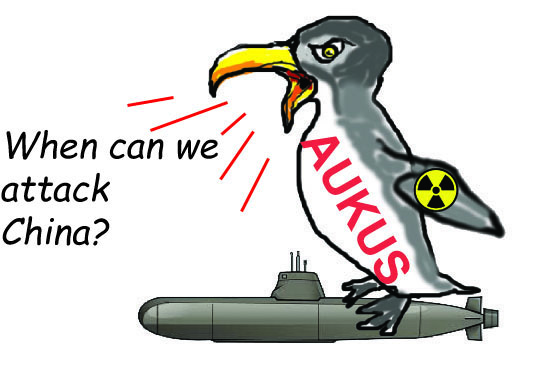
It appears that the real reason for Anson being sent to Australia is for the United Kingdom to demonstrate some capacity in being able to be an active participant in the AUKUS agreement but this may be a rather hopeless exercise in view of the strained relationship with the United States over the Iran war
The lack of naval capacity of the United Kingdom is best demonstrated by the fact that the destroyer HMS Dragon proposed to be send to Cyprus for protection of its naval 1 of 2 base on the island cannot be put to sea due to the incapacity of undertaking the necessary dockyard work for it seagoing status
All of this should be borne in mind when planning for the future development of the AUKUS proposals
It is therefore beyond the wildest dreams to contemplate
the design and subsequent construction of the SSN- AUKUS submarine
How will the Australian government react to this situation when AUKUS is a major part of its defence strategy?
The Australian political landscape is currently being squeezed by a powerful vice. On one side, we are witnessing the alarming and undeniable rise of the far-right, supercharged by a mastery of social media that has the major parties looking like digital dinosaurs. On the other, a growing tide of progressive disappointment with the Albanese government is curdling into outright anger, fueled by perceptions of secrecy, a moral failure on Gaza, and a lack of spine in standing up to the belligerence of the Trump administration. These two forces, seemingly opposed, are feeding off each other, and the result is a political discourse that is becoming increasingly toxic and fragmented.
The most immediate shock to the system is the surging popularity of Pauline Hanson’s One Nation. Recent polling is nothing short of a political earthquake, with One Nation tying with the Liberal-National Coalition on 23 per cent of the primary vote. This isn’t just a protest vote; it’s a realignment. Analysts point to a “perfect storm” of factors: a Coalition riddled with infighting, the “cost-of-living crisis biting hard,” and a sophisticated, decades-long mastery of direct communication.
Senator Hanson and her team have effectively bypassed traditional media gatekeepers. They dominate Facebook and use YouTube for “comedic and sometimes quite bizarre content” that feeds directly into the algorithms that capture younger viewers. This isn’t just politics; it’s a highly effective content engine that peddles consistency and certainty in an uncertain world. The recent call by Labor frontbencher Julian Hill for the Liberal Party to stop “playing footie” with these “populist forces” feels less like a strategy and more like a desperate plea. The horse has already bolted, and it’s wearing a “Please Explain” t-shirt.
The danger here is profound. As an ABC investigation has shown, the lines between populist protest movements and organised neo-Nazi groups are becoming dangerously blurred. While One Nation distances itself from the most extreme fringes, its rhetoric creates the fertile ground in which they grow. When Minister Hill warns that our society is being “ripped apart” and that Muslim women in his community are “scared to go to the shops,” he is describing the real-world consequences of a political debate that has lost its moorings.
If the rise of the hard right represents one side of the vice, the government’s perceived timidity represents the other. For many who voted for change in the 2025 election, the Albanese government has become a cipher. The disappointment is multifaceted, but three failures stand out.
First, there is the perception of secrecy and a lack of courage in foreign policy. The government’s response to Donald Trump’s invitation to join his so-called “Board of Peace” was emblematic. While the world braced for the return of Trump’s brand of disruptive diplomacy, reports emerged that the government’s internal strategy was simply to hope the “hot potato” would “just fizzle out.” This is not leadership. It is a fearful hope that a problem will disappear, a posture that does nothing to assure allies or inform the public.
This timidity pales, however, in comparison to the government’s stance on Gaza. The moral weight of the conflict has landed heavily on Australian shores. There is a deep and growing sense of betrayal among pro-Palestinian advocates, and indeed many human rights-focused Australians, who see a government that has bent over backwards to avoid upsetting Israel. This sentiment is amplified by the international treatment of UN Special Rapporteur Francesca Albanese.
While the news is careful to distinguish between the UN official Francesca Albanese and our Prime Minister, the public discourse often conflates the two, creating a cloud of confusion and frustration. For many, the spectacle of the Trump administration sanctioning Albanese – and her family suing over it – while European nations call for her resignation, is a clear litmus test. Regardless of one’s view of her rhetoric, she is seen as a voice holding Israel to account. Against this backdrop, the Australian government’s quiet diplomacy and failure to issue more forceful condemnations is perceived not as prudence, but as pandering. It looks like a lack of courage to stand up for Palestinian civilians and a capitulation to the same US-led pressure campaign that targets her.
So, here we are. We have a government that appears paralysed, hoping difficult issues will “go away” while simultaneously losing the narrative to a far-right machine that offers simplistic, and often hateful, answers to complex problems. The government’s silence on the issues that matter to its progressive base – whether it’s housing policy or a principled foreign policy – creates a vacuum. And into that vacuum rushes the certainty of the hard right.
The great danger for Australia is that this dynamic becomes self-perpetuating. The more the government fails to articulate a bold, humane, and courageous vision, the more disillusioned voters will look elsewhere. Some will go to the Greens, but a significant and growing number are being seduced by the siren song of the far-right. We are left with a discourse dominated by either the inflammatory culture war talking points of the fringe or the cautious, fearful whispers of a government that has forgotten how to lead. Until the Labor party finds its voice and its courage, this perfect storm will only continue to gather strength.
Today marks three years since a widely criticised media series predicted Australia would be at war with China within three years.
The Red Alert series was published by the Sydney Morning Herald and the Age, and featured a panel of national security experts who claimed war was just around the corner and Australia was woefully unprepared.
“As it turns out all five “experts” were wrong and the authors of the series, Peter Hartcher andMatthew Knott, were also wrong,” said AWPR President and former Senator Andrew Bartlett.
No doubt all of Australia is breathing a sigh of relief today as the threat of annihilation recedes.
While it is easy to make fun of this laughable series of reports, it is depressing to think that the views expressed in the articles are common among establishment defence commentators.
We have had years of fearmongering about imminent threats to Australia, all of which have been shown to lack any credibility. Yet this is what currently passes for mainstream defence expertise.
Rarely does a day go by without a news article featuring a so called expert, demonising our largest trading partner and demanding that Australia spends billions more on the military.
This is despite the fact that the government’s own Defence Strategic Review in 2023 found that there is very little risk of an invasion.
Many commentators regularly suggest that if a war over Taiwan erupted, Australia would be compelled to get involved.
This is a dangerous suggestion and should be rejected outright. The Australian government has the right to decline any US request to join foreign wars.
This is why Australia should urgently re-visit War Powers Reform, which would ensure the whole parliament gets a say on overseas wars.
The John Howard-style ‘captain’s call’ decision-making, which we saw over the Iraq and Afghanistan wars is no longer acceptable in modern Australia” Mr Bartlett concluded.
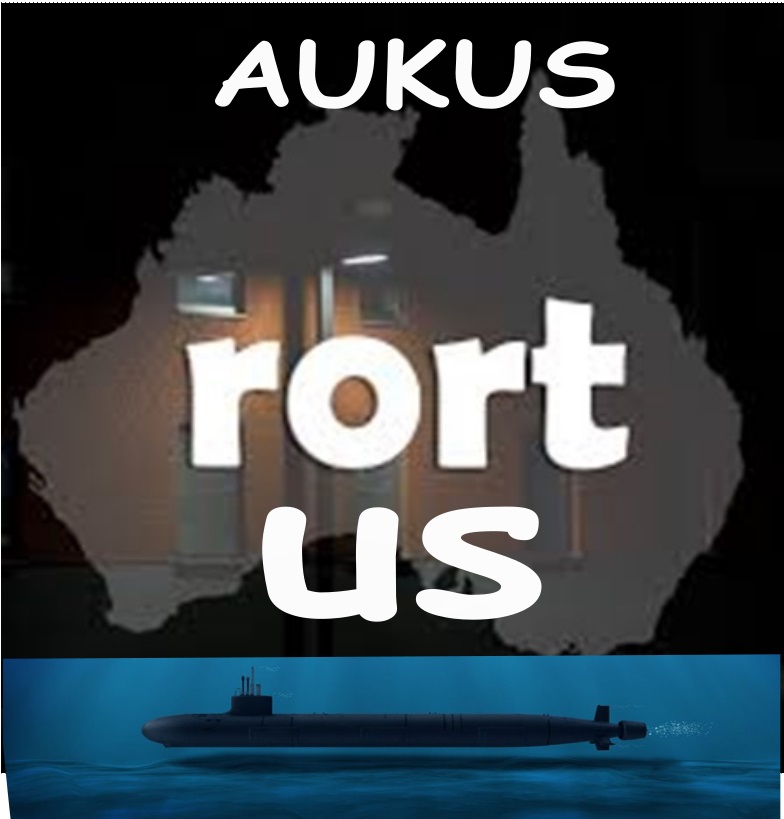
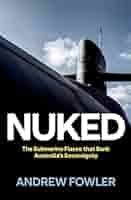
Andrew Fowler’s book Nuked: The submarine fiasco that sank Australia’s sovereignty critically examines the decision by the Australian government – under the leadership of Liberal prime minister Scott Morrison – to enter into the most expensive military acquisition agreement in Australia’s history.
On September 15, 2021, Australia signed a trilateral security agreement with the US and the United Kingdom, known as AUKUS.
The selling point was that Australia would acquire nuclear-powered submarines to replace its ageing Collins-class conventionally-powered fleet. The cost? $368 billion – and possibly, the sovereignty of the nation.
Amid a deep web of lies, deception and media spin, Fowler painstakingly unpacks the extensive efforts Morrison took to deceive the French government as he concocted a highly secretive plan to acquire nuclear submarines.
A mission that, Fowler suggests, has led not only to a massive financial commitment but has ultimately “sunk” Australian sovereignty.
Fowler is well-placed to offer such a deeply penetrating account into Australia’s decision to enter AUKUS. He is an award-winning investigative journalist having previously worked for the ABC’s Four Corners and Foreign Correspondent programs.
Through interviewing many of the main people involved and talking to sources in Paris, London, Washington, and Canberra, Fowler pieces together a devastating account of Australia’s latest military acquisition agreement.
Key themes
Throughout the book, Fowler addresses key themes from the Liberal Party’s long-term desire for closer ties to Washington, to the incremental loss of Australia’s sovereignty in the alliance, and the secrecy around the chain of events that led to the scuttling of the French submarine deal and negotiations for AUKUS.
Liberal Party and US alliance
Central to the story is the long-running narrative within the Liberal Party of Australia’s deep desire to become increasingly tied with the US, despite the lack of guaranteed reciprocity.
From the activation of ANZUS after 9/11, to Australia’s unquestioned following of the US into Iraq, to John Howard’s “captain’s call” on the F35 Joint Strike fighter, Fowler argues that successive Australian governments – particularly conservative Liberal governments – have often made questionable foreign policy decisions to bolster the relationship with the US.
To this end, he shows how even in the lead-up to signing the French submarine deal, there was a push among conservative elements of the Liberal Party to instead go for the inferior Japanese option because that would enable closer cooperation in US-led naval missions.
One of the other interesting issues pointed out was the degree to which the Labor Party felt hamstrung by the agreement. According to Fowler, this was largely due to Labor’s fear of being accused of being weak on matters of national security.
So, pushing back on the agreement was a political minefield ahead of the 2022 election.
Loss of sovereignty
Key to the book is an analysis of the impact of the AUKUS deal on Australia’s sovereignty.
Fowler begins by unpacking the somewhat lopsided history of the alliance as military cooperation grew closer – noting that the Australian government has not always been fully aware of the functions of major military installations like Pine Gap, whose operations, up until the 1970s, had been kept from the government.
Similarly, he touches on the use of other military infrastructure across Australia that is used to relay battlefield commands – and possibly in the future, a nuclear strike.
Fowler makes the case that while there are numerous instances in Australia’s history in which sovereignty has been challenged by alliance partners, AUKUS takes this problem to another level.
Citing a lack of expertise in nuclear-trained operatives, the lack of a domestic nuclear industry, and an acquisition contract in which Australia essentially ceded all negotiating rights, Fowler argues that Australia’s future defence will essentially be at the mercy of the US – a situation that Australia would not have found itself in under the French agreement.
Secrecy and issues in foreign policy
Perhaps one of the most significant issues has to do with the level of secrecy and lack of oversight that is evidently possible in making Australian foreign policy.
Fowler shows how Morrison went about sowing seeds of doubt in the agreement with the French, and used the media to create a sense of urgency by inflating the possibility of conflict with China so that the AUKUS announcement would be received with irreverence.
In doing so, it evaded public debate – and even debate within his own government by keeping the prospective deal secret even from Barnaby Joyce, then leader of the Nationals – on an issue that would ultimately come to undermine Australia’s sovereign capabilities for decades to come.
Conclusion
Nuked is essential reading for researchers and the broader public alike.
Fowler challenges the unquestioning faith in the US alliance held by many on the political right and advances a compelling narrative of Australia’s loss of sovereignty as it edges closer and closer to the US.
The book comes during a critical period in the Australia-US alliance. When written, Joe Biden was in the White House.
While many of the book’s criticisms speak to issues around the decimation of Australian sovereignty resulting from AUKUS, the re-election of President Donald Trump certainly amplifies the need for a critical re-evaluation of AUKUS as the US seems set on departing from its democratic ideals.
Significantly, Fowler raises important questions not just about the future viability of AUKUS, but of the processes of future military acquisition and the significant gaps in checks and balances when it comes to foreign policy decision-making.
The broader implications of AUKUS are immense. Given the political climate and the growing concerns around the viability of AUKUS, the importance of this book has grown.
Overall, Fowler provides the reader – whether an academic or lay person – with a well-written, comprehensively researched account of the events that resulted in the sinking of the French submarine deal through stealth-like manoeuvring to establish AUKUS.
The era of British nuclear testing in Australia was exrraordinary, and its secrets are still being uncovered. Because of ongoing British secrecy, we may not discover them all. In her talk Professor Tynan will examine the complex circumstances taht led the British first to Monte Bello Islands off the coast of Western Australia, then Emu Field and Maralinga in South Australia, to test their atomic weapons. The decision to do so followed the United States’ exclusion of Britain from nuclear weapons and energy R&D after World War II, ostensibly because of the detection of Manhattan Project spies. Australia acquiesced to the atomic tests without asking hard questions, and as a result considerable damage and suffering was inflicted, particularly on Indigenous people and service personnel.
Those hard questions only came decades later, and there are still many to be asked. The British conducted their testing with a greater emphasis on speed than safety. The recklessness of some of the tests carried out in Australia is stunning. Tynan will share specific stories of these dangerous tests and their deadly ramifications for Australians. She will also cover what happened after the British terminated the test series and deliberately misinformed the Australian government about the extent of contamination they left behind. All three test sites were abandoned without proper remediation. The aftermath led to a judicial enquiry, known in Australia as a Royal Commission, in the mid-1980s. This enquiry makred a major shift in Australian attitudes to the tests, and was an important mileestone in an era of uncovering and truth-telling that continues.
Professor Elizabeth Tynan is Head of the Professional Development Program at James Cook University’s Graduate Research School, where she teaches academic writing, editing, and critical thinking skills to postgraduate researchers. She is a former science journalist in both print and broadcast media. Her PhD from the Australian National University examined aspects of the British nuclear tests in Australia in the 1950s and 1960s.
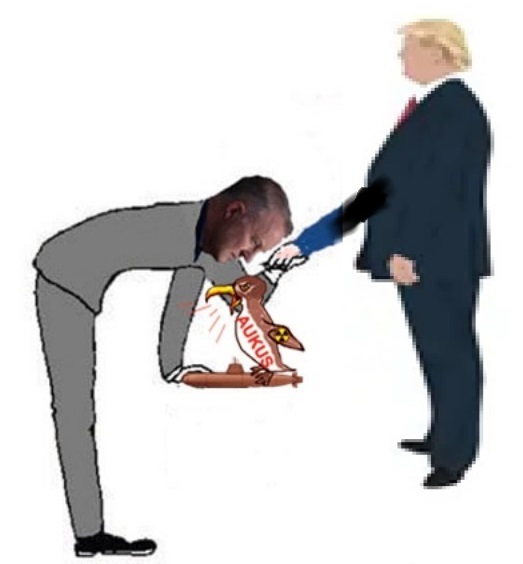
The Australian prime minister, Anthony Albanese, gave Donald Trump a gift of a model nuclear submarine with golden plates and finishes, internal documents reveal, during his visit to the White House last year which sealed the president’s support for the Aukus pact.
The prime minister also presented the US first lady, Melania Trump, with a A$3,000 Paspaley pearl pendant.
The information, obtained by Guardian Australia from the Department of Prime Minister and Cabinet after a four-month freedom of information process, revealed more about the delicate diplomatic planning and charm offensive that went into Albanese’s long-awaited first face-to-face meeting with Trump.
“Gift form” documents from the department reveal Albanese came to the White House bearing a two-foot-long model Virginia-class submarine, mounted on a base with gold plates, and a pearl necklace from one of Australia’s most famous jewellers.
Albanese had previously stated he’d given the Trumps a model submarine and jewellery, but at the time neither Albanese’s office nor his department would reveal any further information about the gifts.
The decision by Adelaide University to withdraw a venue booking for an event featuring a leading United Nations human rights expert has ignited a fierce debate about academic freedom and censorship in South Australia.
The controversy surrounds a panel discussion titled “Settler Colonialism: What It Can Tell Us About the Conflict in Israel/Palestine,” which was scheduled to be held at the university’s Elder Hall. The event is part of the Constellations: Not Writers Week, a breakout festival created in response to the recent cancellation of the official Adelaide Writers’ Week.
The panel features Francesca Albanese, the United Nations Special Rapporteur on the Occupied Palestinian Territories, who was to appear via video link, alongside esteemed historian Henry Reynolds and UNSW academic Lana Tatour.
According to event moderator Chris Sidoti, Elder Hall had been booked a month in advance. However, on Tuesday, the university informed organisers that the booking was being revoked, citing “health and safety” concerns.
In a statement, an Adelaide University spokesperson defended the decision, stating they were only made aware of the external event the previous Friday. The university claimed it could not accept the booking because it:
“… did not go through the required review and approval process in accordance with the required policy and procedure.”
The spokesperson added that the university could not “ensure the safety, respect and comfort of those attending” and suggested an alternative venue – the National Wine Centre – at a significantly higher cost of $23,500, compared to the $750 fee for the university hall.
This explanation has done little to quell the criticism. Mr. Sidoti described the move as a “sad reflection on the state of Adelaide University today,” arguing that the institution’s core role is precisely “to provide forums for these kinds of discussions – and it’s failing in that.”
The cancellation has drawn sharp rebukes from political figures, who see it as part of a worrying trend of silencing dissenting voices.
Democracy education resources
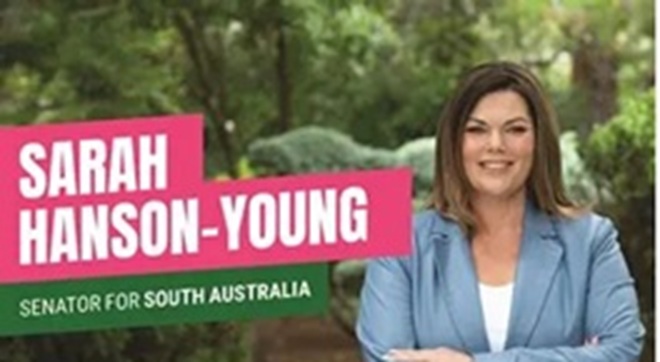
Greens Senator for South Australia, Sarah Hanson-Young, demanded the university explain its actions, calling the reports “concerning.” She linked the decision to the earlier controversies surrounding Writers’ Week, suggesting a broader “culture of fear infecting our institutions.”
“You cannot cancel curiosity, you cannot cancel compassion, and you cannot silence a city that believes in the exchange of ideas and freedom of expression,” Senator Hanson-Young said. She accused the university of capitulating to external pressure, stating that “seeking to silence a distinguished international human rights expert undermines academic freedom, weakens intellectual integrity, and contradicts the very principles universities are meant to uphold.”
The event is part of the Constellations festival, which was formed after the official Adelaide Writers’ Week was cancelled this year. That decision followed the withdrawal of hundreds of authors protesting the treatment of Palestinian-Australian writer Randa Abdel-Fattah, who was controversially uninvited from the original lineup.
When questioned directly about whether concerns regarding Ms. Albanese’s appearance – particularly in light of past criticism and US sanctions – influenced the decision, the university spokesperson did not provide a direct answer. They reiterated that the institution prides itself on being a place for the free exchange of ideas.
Event to Proceed at New Venue
Despite the university’s withdrawal, the discussion will go ahead. Organisers have secured the Norwood Concert Hall in Adelaide’s eastern suburbs for Thursday evening, where a sold-out crowd is expected to attend.
Senator Hanson-Young highlighted the public response as a rebuke to the university’s decision:
“Thankfully the event will go ahead… showing that South Australian audiences aren’t as fearful as these institutions,” she said.
Through AUKUS, federal Labor are ‘normalising’ and legitimising High-Level nuclear waste.
The public has a right to full disclosure in an informed debate ahead of AUKUS nuclear decisions. Silence by political leaders paves a path for an AUKUS nuclear dump agenda.
Federal Labor has broken its commitment to announce a process for AUKUS waste storage
Through AUKUS, federal Labor are ‘normalising’ and legitimising High-Level nuclear waste
Minister Marles wants to put a flag on US Navy High-Level nuclear wastes and ‘call it our own’
Aboriginal People have a Right to Free, Prior and Informed Consent over AUKUS wastes
SA Premier to let ‘national security interests’ decide the location for AUKUS nuclear waste
Scenario: AUKUS nuclear waste to ship into Whyalla Port to go north to the Woomera Area
The Australian public have a Right to Say No to undemocratic new federal Labor powers to impose AUKUS High-Level nuclear waste, effectively by decree, across SA, WA and the NT.
AUKUS Regulation 111 (02 Oct 2025) overrides protections in our existing State and Territory laws, and specifically names and prescribes SA and WA laws that prohibit High-Level nuclear waste storage. These draconian federal powers lack social licence and are an affront to civil society, they damage public trust in governance and are an ongoing threat to Aboriginal People’s rights and cultural responsibility to protect their country.
The Objects of the SA Nuclear Waste Storage (Prohibition) Act 2000 set out what is at stake: “To protect the health, safety and welfare of the people of South Australia, and the environment in which they live” by prohibiting certain nuclear waste storage facilities.
Community now face federal imposition of untenable and illegal AUKUS nuclear waste storage,
see “The lethal legacy of Aukus nuclear submarines will remain for millennia – and there’s no plan to deal with it” (The Guardian, 10 August 2025, Interview with Prof Ian Lowe).
Federal Labor has broken its commitment to announce a process for AUKUS waste storage: AUKUS Minister Richard Marles MP made a commitment to announce a process to identify a site to dispose of AUKUS nuclear wastes by early 2024. The failure by Defence to set out any process – other than to take up powers to impose nuclear wastes by decree – is unacceptable.
‘Transparency warrior’ Rex Patrick has brought to light: “A Brief on how to choose a location for AUKUS nuclear waste was provided to Defence Minister Richard Marles in Dec 2023”, see “Submarine boasts, yet nuclear waste dumps submersed in secrecy” (MWM, 16 Feb 2026).
The public has a Right to Know what regions across SA, WA and the NT are being targeted for storage of AUKUS nuclear wastes. The secretive ongoing Defence review “to identify potential nuclear waste disposal sites” (ABC News March 2023) and the Brief must be made public.
The Woomera Area was reported to be a ‘favoured location’ for storage and disposal of nuclear sub wastes back in August 2023, see “Woomera looms as national nuclear waste dump site including for AUKUS submarine high-level waste afr.com. WA, Qld and Vic political leaders rejected a High-Level nuclear waste disposal site in their States in 2023. WA has suggested the Woomera Prohibited Area in SA: “would be one obvious location within the Defence estate, however, we will await the outcomes of the federal review” (SMH 15 March 2023).
Through AUKUS, federal Labor are ‘normalising’ and legitimising High-Level nuclear waste. Aspiring International nuclear waste dumpers Tellus Holdings Ltd that operates the Sandy Ridge waste repository in WA has partnered with Amentum UK to expand the Chandler Project in the NT. Amentum provides services to Pine Gap and was involved in the “Waste Isolation Pilot Plant” – the only nuclear geological repository in the US. In a Jan 2026 submission to a federal Inquiry Tellus offered to first take AUKUS & International Low-Level waste at Chandler.
The public has a right to full disclosure in an informed debate ahead of AUKUS nuclear decisions. Silence by political leaders paves a path for an AUKUS nuclear dump agenda.
Min Marles wants to put a flag on US Navy High-Level nuclear wastes and ‘call it our own’: AUKUS Minister Marles aims Australia take on second-hand US Virginia Class nuclear powered subs in the early 2030’s loaded with US origin military High-Level nuclear fuel waste accrued in up to a dozen years of US Navy operations of US ‘High Enriched Uranium’ nuclear reactors.
Swapping an Australian flag onto this US military nuclear reactor waste places an untenable ‘for ever’ burden on future Australian generations to have to try to isolate these US nuclear wastes.
Aboriginal People have a Right to Free, Prior and Informed Consent over AUKUS wastes:
Q: Will our political leaders commit to respect and comply with Aboriginal People’s human rights, set out in the United Nations Declaration on the Rights of Indigenous Peoples Article 29 (UNDRIP 2007), to “Free, Prior and Informed Consent” over storage of hazardous materials on their lands. AUKUS nuclear wastes absolutely are hazardous materials! Traditional Owners across SA, WA and the NT have repeatedly had to Say No to the imposition of nuclear wastes.
The SA Premier was called on to declare his position back in Dec and has so far not responded.
SA Premier to let ‘national security interests’ decide the location for AUKUS nuclear waste:
Premier Peter Malinauskas MP has said AUKUS nuclear waste should go to a ‘remote’ location in the “national security interest”, see “Site for high-level nuclear waste dump under AUKUS deal must be in national interest, SA premier says” (ABC News 15 March 2023).
The Premier’s “Office for AUKUS” (Letter, 07 Oct 2025) claims “safe and secure disposal” for High-Level nuclear waste, including spent fuel, produced when N-subs are decommissioned. The Office expresses no concerns over globally unprecedented High-Level nuclear waste disposal, declines to reveal what is underway and yet expects “community acceptance”:
“Determining suitable locations and methods for safe and secure disposal will take time, but Australia will do so in a manner that sets the highest standards … and which builds community acceptance for a disposal solution.”
Ahead of the SA Election the Premier has been called on to answer the Q: Will you accept or reject federal imposed storage of AUKUS nuclear waste in SA? so far there is no response.
REPORTER: Is a high-level nuclear waste dump the price that South Australia will have to pay for the jobs that go to the state? (Minister Marles Press Conference 14 March 2023)
MARLES: Well, as I indicated there will be a process that we will determine within the next 12 months for how the site will be identified. You’ve made a leap there, which we’re not going to make for some time. It will be a while before a site is ultimately identified.
SA is left in the dark, without a say, as an ongoing target for an AUKUS nuclear waste dump
Scenario: AUKUS nuclear waste to ship into Whyalla Port to go north to the Woomera Area
The Woomera Area is expected to be a target on a federal regional short list for an AUKUS nuclear dump site and Whyalla Port to be on a likely AUKUS nuclear waste transport route.
Rex Patrick has set out an array of potential locations and types of AUKUS nuclear waste facilities across Australia, see “AUKUS waste in perpetuity” (MWM, 22 July 2025). For further information: see Friends of the Earth https://nuclear.foe.org.au/nuclear-subs/
Or, Why Australia chooses to live in the lies of an American world
Burning Archive, Substack, Mar 07, 2026
Australia feinted on the global stage this week when Canadian Prime Minister Mark Carney went to Canberra. Offered dignity as a middle power, the Australian Government acted the pawn in another USA-run war.
Disappointing, but what I have come to expect, and we have to deal with the world as it is, right? Or, so the realist fictions say. But let me tell you a stranger history of the plural Australian experience, and how this decolonised nation came to be that way.
Contemporary Australia’s muddled national sovereignty is the product of three botched decolonisation projects:
Federation as White Dominion, 1890-1920;
USA Agent in a British Commonwealth, 1930-50;
Deputy Sheriff and Starlet in the USA’s Liberal Empire, 1968-1999.
You may not have heard these labels; I devised them for this essay. But don’t worry: I explain the history and evidence behind them at the end of this post on Australia’s experience of decolonisation.
Mark Carney’s Wake-Up Call to Independence
In each of the three botched decolonisation projects, Australians – both élites and masses – chose belonging to an empire, which claimed global supremacy, over modest, gregarious co-existence as a middle power of one earth.
Now, in 2026, another historic opportunity for decolonisation has arisen. It was announced to the Australian Parliament by the Prime Minister of another decolonised dominion, Mark Carney of Canada.
“Yes, the world will always be driven by great powers, but it can also be shaped by middle powers that trust each other and act with speed and purpose.
Mark Carney, Address to Parliament, Hansard, 5 March 2026
Will Australia seize the moment? Will we act with speed and purpose? Will Australia ride, or get dumped by, a fourth wave of US American decolonisation, by the unravelling of the USA Empire?
My hunch is: we will get dumped, and then sucked out with the rip into the most dangerous waters. Like a bad cocky swimmer in rough surf, we have not been paying attention to the world “as it is” around us, and not even swimming between the flags.
At least, the mainstream élites in politics, business and culture in Australia have not been paying attention. The omens of this opportunity for a new decolonisation have been noticed in the Great Southern Land, for a decade or more, by a few dissident, reviled voices. Like antipodean Havels, we have tried to live in the truth, and point out the lies and slogans our leaders ask us to hang in our shop windows, like the indispensable American Alliance, our great and powerful democratic friend, and the ‘liberal rules-based international order,’ exposed as a sham by Mr Carney at Davos. But Australian leaders have suppressed all readings of the omens. They have blocked their ears and masked their eyes. They refuse to see Australia as anything but the Deputy Sheriff of the USA’s Empire or some B-grade celebrity starlet aspiring to be enriched by Rupert Murdoch’s global media empire.
The Closing of the Australian Mind
The Australian mind is closed and colonised, like few around the world. It may be because Mr Murdoch has so successfully counter-colonised the political and cultural networks of imperial masters, Britain and the USA. It may be because we botched our past three attempts at decolonisation, and the gulfs have washed us down. It may be that we have been unlucky in our leaders. But I suspect, most deeply, it is because, in each attempt at independence, we neglected one crucial truth: colonisation begins and ends in the mind.
It’s only Day Five of the war, but surely the epic stupidity of Australia so cravenly backing the US-Israeli invasion of Iran is evident by now. Michael West reports.
We are led by fools and sycophants. The illegal, unprovoked invasion of Iran is not just garden-variety stupidity. This is stupidity on a grandiose, stratospheric scale.
The Israeli propaganda narrative that Iranians would sprinkle rose petals at the feet of their invaders has not come to pass. It has already been demolished in fact.
Instead of bringing freedom and democracy – ‘regime change’ – we have brought chaos, possibly a world war, and definitely the destruction of the Middle East. The world economy is being hit hard as we write; oil prices spiralling, energy prices about to soar, and the inexorable spectre of inflation and recession.
“And it didn’t have to happen.“
This was a war of choice. Even without the “Epstein Coalition” – as the Iranian media so aptly dubs their invaders – murdering 168 Iranian school girls on day one, ‘peace through strength’ was never going to happen.
Quite the contrary. The illegal and unprovoked invasion of Iran has hardened the resolve of Iranians, who are massing in their hundreds of thousands across the country to mourn their dead and chant Death to America, to back their regime.
Where was the advice?
The Epstein Coalition killed the Ayatollah, who was actually against nuclear power; he was a moderate. Did Albo and Penny Wong not seek advice from Foreign Affairs that attacking Iran was folly, that the anti-regime protestors were a minority, that the pre-invasion protests were a Mossad and CIA psyop, that Iran might attack US proxy states in the region, that invasion would be a Brobigdadgian mistake?
Or did they ignore the advice in favour of a Washington regime compromised by the Epstein pedophile scandal?
And now, we see the feeble, hypocritical whining by Israel and its supporters about Iran attacking the Gulf states. Is that our only moral defence? Decades of supporting these regimes: Bahrain, Qatar, Kuwait, Saudi Arabia, and the United Arab Emirates – US proxy states all – regimes now unravelling, the oil price is soaring, inflation and recession are beckoning globally.
Images are emerging from Bahrain of locals cheering on the Iranian missiles. Were DFAT and our politicians unaware of popular angst in the Gulf states against American imperialism?
And what did they expect Iran to do in the face of this existential threat? Not blow up American bases and infrastructure while the US attacked them; after the US betrayed them at the very negotiating table when they were offering significant concessions on nuclear enrichment, all to avoid war? This war.
Australia, the US flunkies
Yet here was Australia, Saturday night, first out of the blocks worldwide to throw its support behind Donald Trump and his preposterous “Operation Epic Fury”, a probable pedophile being blackmailed and led around by the genocidal Benjamin Netanyahu like a pony at the fairground show.
“Operation Epstein Fury”, it was fast labelled. The soaring, craven stupidity is hard to grasp. Both major parties backing it. Albo first, then Angus Taylor rushing to tow the Donald’s line. Then, Pauline Hanson, too, who even congratulated and praised Netanyahu. We are led by fools and sycophants.
The flawed defence of atrocity
To address the empty rhetoric of the pro-war lobby, criticism of this war does not equate to support for the regime in Iran. Defenders of the US-Israel atrocity are busy with their swarms of social media bots peddling the argument that “you are an Islamist terror supporter” if you criticise the invasion.
This is the 2026 version of “You are a Hamas supporter” if you argue against genocide in Gaza.
The cold facts of this debacle are that regime change does not work, that Iran did not want this war, that Iran appears to be exceptionally well prepared – even winning the war – that the Epstein Coalition, which Australia supports, is daily backing war crimes: blowing up hospitals, schools and civilian infrastructure.
“This is a war which has already been lost.“
The obvious reality is that regime change wars are a demonstrable failure. Vietnam. Iraq. Afghanistan. Iraq – a million dead, irretrievable regional stability. In Afghanistan, 20 years, trillions of dollars spent, four US presidents, six Australian PMs – all to replace the Taliban with the Taliban.
And here we are, the world’s busybodies, doing it again.
Who would ever negotiate with the US in good faith again, or Israel for that matter? Iran did not want this war. Iran has not attacked another country in 300 years.
The US lured them to the negotiating table, then, without warning, murdered their leadership. This echoes last year’s 12-day war, where Israel and the US lured them in on the premise of good faith talks, then murdered them and now play the victim.
What did they expect Iran to do in the face of this existential threat?
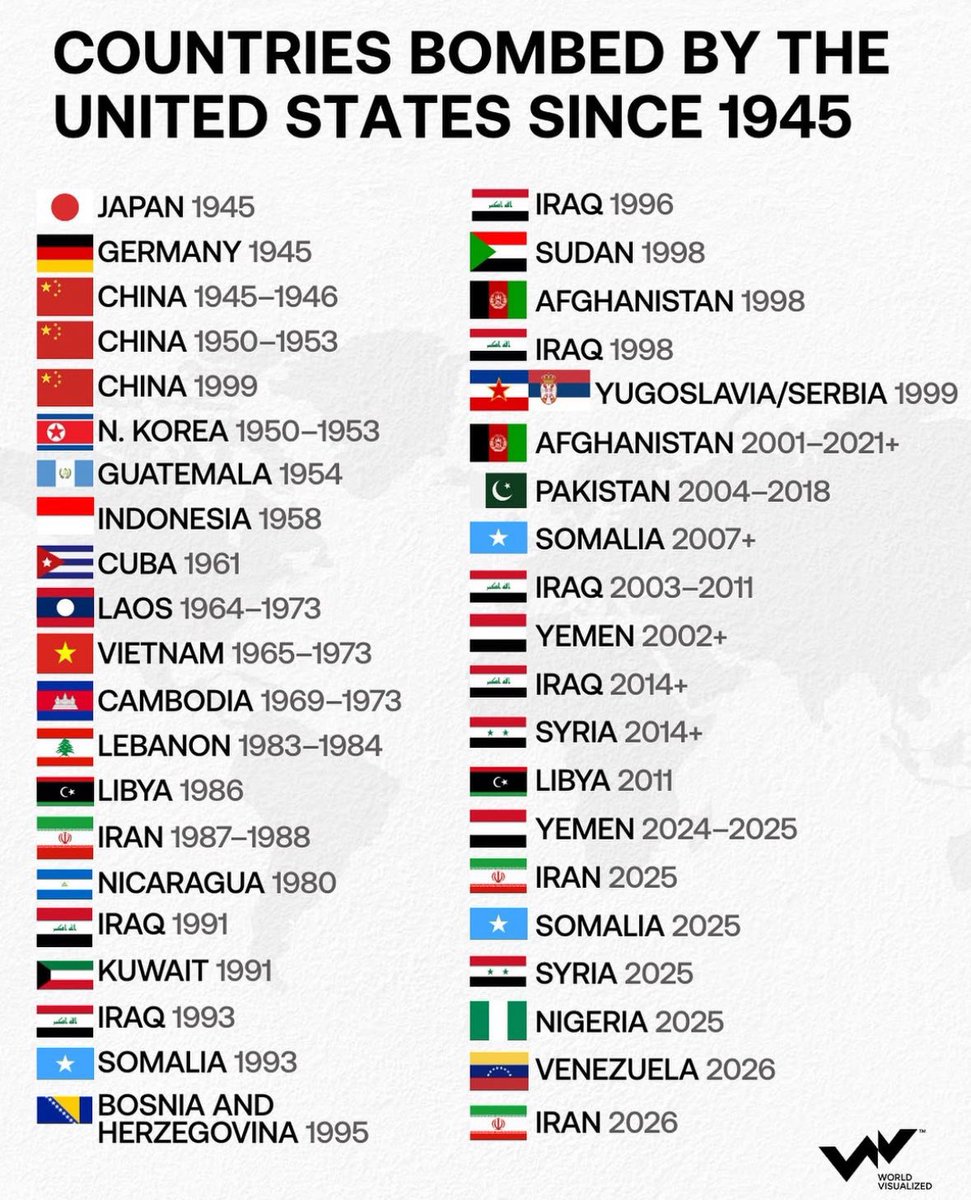
The record speaks for itself. The US is the biggest invader of other countries in history. Israel has, last year alone, attacked Iran, Iraq, Lebanon, Yemen, Jordan, Palestine, Qatar, Tunisia, Malta, and Greece.
Six illegal attacks of sovereign nations, as well as three illegal attacks in international waters equals 9 all up. In one year. And now they are invading Lebanon again, seizing more territory as their puppets, America, fight their campaign against Iran.
Albo, what are you doing?
We know who the war mongers are. We are the war mongers. Yet, in his bizarre statement of support, Prime Minister Anthony Albanese was the fastest out of the blocks of all the allies on the weekend, issuing a false statement.
The claim, echoed by the usual warmongers of the Lib-Lab establishment, is that Iran is guilty of attacks on Australian soil, referencing alleged attacks on a deli in Bondi.
We know who the war mongers are. We are the war mongers. Yet, in his bizarre statement of support, Prime Minister Anthony Albanese was the fastest out of the blocks of all the allies on the weekend, issuing a false statement.
The claim, echoed by the usual warmongers of the Lib-Lab establishment, is that Iran is guilty of attacks on Australian soil, referencing alleged attacks on a deli in Bondi.
Then there is the age-old claim that Iran is about to produce nuclear weapons. The US and Israel’s nuclear risk claims have been so roundly discredited it’s a joke.
Benjamin Netanyahu has been trying to instigate a war against Iran for 30 years – claiming Iran is days away, weeks away, months away from nuclear missiles.
And they were at the negotiating table again when the Epstein forces murdered them.
The propaganda
We are now seeing mainstream media decry the ‘illegal attacks’ on Israel and the Gulf states. Yet the ‘victim card’ is tapped out. Around the world, outside the legacy media propaganda, there is little sympathy for Israel having razed Gaza and slaughtered between 72,000 and 700,000 Palestinians while stealing more land in the West Bank daily.
It will continue. The media and political classes have failed so majestically that they can only try to salvage their authority with more propaganda.
The deplorable coverage of the murdered schoolgirls in Iran is a case in point. The “40 beheaded babies” and the “mass rapes” of Hamas filled the headlines in the West on October 8, 2023. Yet real murders – 170 murdered schoolgirls – have hardly rated a mention. Yes, a mention perhaps, but a side story, buried, no headlines of outrage.
Can’t handle the truth?
Is the truth too hard to handle? Is it not evident to everybody except the most brainwashed advocate of the Epstein lobby that Israel – the government, the state – is the problem here?
Netanyahu has won his ambition to drag America into a war against Iran, and if you follow the money, while world stock markets teeter, the stock market in Tel Aviv is surging, replete with weapons companies as it is.
Meanwhile, the ASX is tanking, ergo our savings. Oil prices are surging, ergo higher energy prices and inflation. The Houthis, Iran’s allies, are shooting again in the Red Sea while, on the other side of the Arabian peninsula, Iran has blocked the Straits of Hormuz, choking off a large chunk of the world’s oil supply.
Higher prices in India and China will mean higher prices for imports and inflation around the world.
The lessons of history have not been learnt; in fact, they have been discarded in spectacular fashion.






 Antinuclear